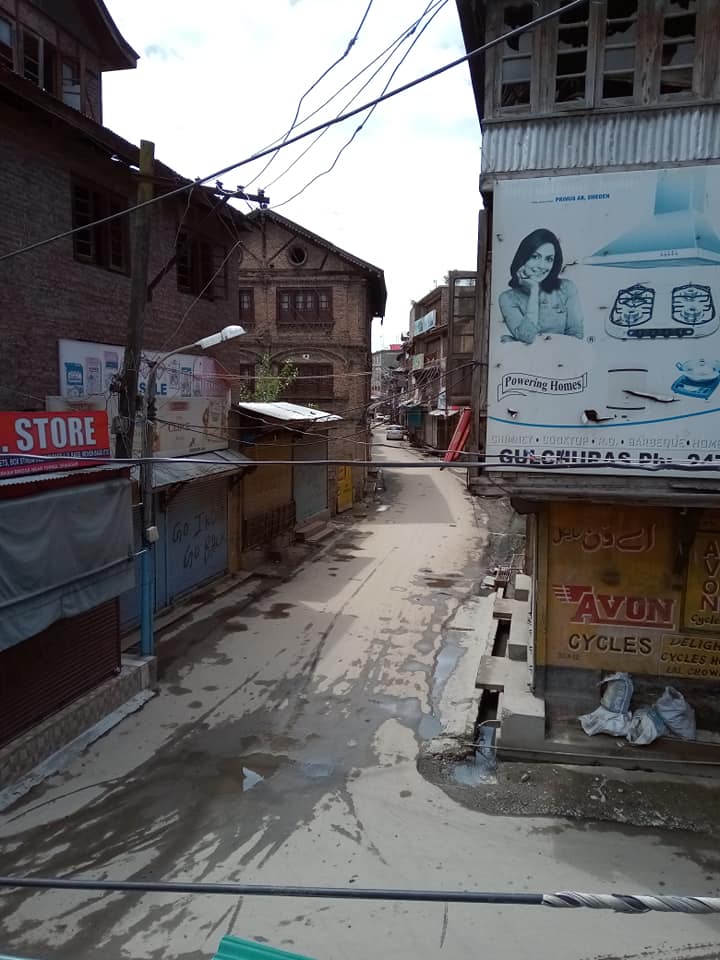
There is a bar where the boys have stopped talking/ They
have been sentenced to death by the blues – Take This Waltz, Leonard Cohen
What did you see, my blue-eyed son? I saw ten thousand
talkers whose tongues were all broken - Hard Rain’s Gonna Fall, Bob Dylan
They make a desolation and call it peace – Agha Shahid Ali,
Farewell, The Country without a Post-office
In Kashmir, time behaves like water these
days, fitting any shape it flows into. There is a lot of it, sitting idle like
the houseboats on the Dal. The tourists have flown away and the political heat
has become palpably pronounced in the valley lately, affecting everything it
touches.
“Rivers of blood will flow on the streets,
when the siege lifts,” says the vegetable vendor, his voice rising in
indignation. He has not sold much this morning. His boat is still filled with
his ware: pumpkins, tomatoes, and other fresh produce of the season. “The
vegetables are in abundance this year,” the patriarch at the houseboat I am
staying at told me before I left for the floating vegetable market, which
assembles every morning at the Dal.
The traffic at the market is low. "Generally,
we have a thousand boats assembling every morning. But today, only hundred vendors have
turned up. It has been like this since August 5th,” the vendor informs, in a resigned tone. I ask him for his name but he declines. His large
eyes reflect fear in the early morning light falling gently on the rippling
waters. “Everything is shut down. Patients cannot get to hospitals. Children
cannot go to schools,” he says, agitated.
At the market, I meet a retired policeman,
who stands on a wooden pier, taking in the view and the bubbling conversations
in Kashmiri. There are few buyers so it is mostly the vendors calling to
each-other, chatting. I see a TV crew, young women and men, also standing on
the pier, looking at the crowd through their cameras. They are also flying a
drone over the market which makes quite a racket but they seem oblivious to
that.
The retired policeman is thin and wiry and
he resembles someone I know – he is small but with sophisticated features and a
fair skin- the twinkly eyes and the big grin gave him an elfish aura. He jokes
about the drone. “They will show this and say all is normal here,” following it
up with a big laugh.
He mentions the P. Chidambaram case while noting how far the Central government could go in silencing the
opposition. The former finance and home
minister of the Congress party had been arrested – it happened the day
before. Chidambaram had tried to evade arrest and was finally apprehended after
he appeared at the Congress headquarters. I would learn of the drama only after
reaching Delhi.
In Kashmir, all the political stalwarts of
various political parties have been put in jail. He says Farooq Abdullah, the
son of Sheikh Abdullah, the Lion of Kashmir, was implicated in some scam for
which he could be tried in courts, thus making him unable to mount much of an
opposition – he remains in jail.
“I have carried India’s gun on my shoulders
for forty years,” his tone is very serious now. He has never seen such a
repression, he says. All around us, tall mountains stand guard, encircling the
lake which can be traversed fully in no less than three days, says the boatman
who takes me there. For the past four days that I have been on the houseboat
where he works, he hardly spoke a word to me. But something has loosened his
tongue now, as he rows us back. His assistant, however, a young man with a
stubble, keeps absolutely quiet, only nodding his head at times in assent.
The boatman’s concerns are more of an
everyday nature. “Will we eat Modi’s head if we do not work and earn a living?”
he complains. The rowing of the boat makes a gurgling sound; birds are cooing.
“They shoot at the stonepelters,” he pauses. “Only God listens, no one else,”
he intones resignedly. “They do not show what is real news.” Another vegetable vendor passes by. His wares are
mostly unsold. I say Salaam to him and he responds back. “Not much sale today?” I
ask. “No,” he says softly. Not many came today, I say. He agrees. How is
everything? I ask him. It’s great! he says, surprising me a little. Perhaps,
that’s what he wanted, to give me an answer I was not expecting.
The boatman is worried that militancy will
rise as a result of the repression. “More young boys will take to the gun now.”
On the way, he chats up others, couple of them look like owners, one of them
brushing his teeth, on the houseboats which are deserted. The voices carry well
long distance on the waters, clear like the daylight breaking through.
This was the fifth day in Kashmir that I
had spent. I was leaving the same afternoon, back to Delhi.
The Himalayan range becomes visible as the
aircraft hovers over Kashmir valley. The peaks of the mountains are without any
snow. The clouds cast a shadow, made darker by the verdure dotting the mountains. Dense but scattered pockets of habitation can
be seen.
I have been reading on the plane a book I
picked up, by an American who tried to reach Tibet through Leh by mostly
walking, and used Kashmir, Srinagar in particular, as his base. He was caught a
couple of times, then left the state to live and work in Bihar at a factory
then being set up by the Tatas. He had arrived in the city in the early 1900’s
and was gawked at by everyone – there seemed to be a lot of Hindus living there
too, working as teachers or in the government. He had a hard time as he was
entirely without money there but it seemed very far removed from the conflict
that characterises the city today. He could cycle through it without any
difficulty, he wrote.
***
“Father does not know where the son is,”
says the boatman who drops me to the houseboat. Mine is called Yellow Submarine
– it is fully yellow – and is standing next to one called Young Normandy.
I see one called Dil Ka Badshah as we make
our way to Yellow Submarine, from Ghat number two where I got down, to Ghat
number one where the houseboat is – the owner is known to me and my wife, also
a journalist, from previous trips. The word Ghat makes me think of Agha Shahid
Ali and the moving essay Amitav Ghosh wrote as an elegy to the great Kashmiri
poet, The Ghat of the Only World.
I also see a woman cutting a whole fish at
a houseboat, sitting down. It looks like trout caught fresh from the lake. The
very domestic nature of her act, when the whole state is under a Lockdown,
seems to be an act of defiance, the way everyday living and its struggles can
surmount anything.
Later, sitting at the houseboat I hear the
afternoon namaz being offered from a nearby mosque. The patriarch of the
houseboat, a sprightly old man with an immaculately trimmed salt and pepper
beard asks me if the sugar in my tea is fine. He is taking his grandson, a
young boy, for a haircut. It is perhaps something he was planning to do but had
to wait for the curfew to ease a bit. I would later find out that barbers were in demand as most of them working earlier were from other
states and left after the Lockdown started. Some who had left the trade had
made a comeback and were doing well, a newspaper article said.
At night, after dinner, the patriarch is
skeptical about the government’s decision to open schools – it is Monday
tomorrow– No one will attend, he says. The offices? He thinks the same. “The
Kashmiris are not going to help Government of India present a picture of
normalcy to the world. We know now is the time to protest and our plight will
be forgotten if we fall for GoI’s tricks to make Kashmir seem normal.”
The next morning, I make my way to the
city. Rumi, the hefty-looking son of the patriarch, comes with me to show me
the way. Rumi has a curious way of talking. “Inhone bina matlab ka issue-ment
bana diya (they made an unnecessary issue of the whole thing),” he says about
the Indian government abrogating article 370 in the state. “Yahan tourists aate
the, enjoy-ment karte the(tourists used to come to enjoy here),” he says
regretfully about the tourists being forced to leave. The houseboat has only
one guest, me.
I want to check out the colony called
Barbarshah where Pundits used to live for an assignment from an Indian newspaper. It is very close to the Lake. Rumi and I walk along for a while. On my
left, as we walk on the bridge, are more houseboats- one is filled with
provisions. Rumi leaves as we reach the corner of the street.
As I walk by, I see a military camp on my
right. I walk straight past it, as a dog suddenly starts to bark. There are
concertina wires lying next to the road, with garbage.
Rumi told me to walk inside the colony
through a gate which opened into a
temple but I see it is closed, and barbed wires have been used to block the
entry. I see a posse of soldiers a little further, very close to another entry
to the colony. A group of men huddle a little further ahead. I am not sure
whether to approach them for directions or just to chat. I decide against it
and walk by, crossing the soldiers, who are joking among themselves. One asks
another about the process of getting a home loan from a bank.
I want to go to Residency Road instead, and a
middle-aged man on a scooter has told me to keep straight on the street where I
am going now. As I cross the soldiers, a
man wearing a sweater, and trousers, short hair and a short mustache, falls
into step with me. I offer him Salaam but then notice he is wearing a Tilak. He
ignores my faux pas. I see some pigeons inside the concertina wires on the
pavement as we walk on the side of the street. More soldiers in bunkers watch
over us.
He tells me he has a shop where he sells
woolen garments. Business is of course bad, he says. I desist from asking the
obvious question: are you happy with the abrogation of article 370?
As we turn the corner, he says what has
been done is for the better. Kashmir is now a part of India for good. He has
been out of touch too with the outside world but hopes things will get better
soon.
He shows me the way to Residency Road where
the newspaper offices are. After that, he goes his way.
The walls next to the press enclave’s entry
are full of boards announcing different newspapers and magazines with their offices.
Some posters announce programs organised by the publications.
I walk up the stairs to an office building. At the Rising Kashmir office, I see only one person, the
photographer. He is cordial. “Oh! I have not met Shahid in a long time,” he
says, almost wistfully, when I ask about my friend who used to work there.
At the Greater Kashmir office, the
reception is open and someone is taking calls. Another person is sitting next
to him, and he is chatting up another visitor. It takes me a while to get their
attention.
The man fielding the telephone tells me finally
that the journalist Ali I was looking for had not come to office since the
siege began and they did not know where to find him. I am disappointed but I do
not press. I ask for a copy of the newspaper and keep it with me.
On my way out, I see a man in a French-cut
beard leaning against a Maruti-800. He is wearing a kurta and chooridar salwar
and looks like a journalist. I ask him the way to Ayesha Mall. He gives me
painstakingly detailed directions, and even repeats them before I leave. But he
cautions me that it would likely be closed.
I decide to take my chances. I walk past
the park on my right, then take a turn and come across a bridge which I climb.
There are very few people out on the streets. Only medicine stores are open.
I walk under a flyover that the bridge
leads to and reach a roundabout. A little more walking straight and I see the
mall.
It is a tall building, fronted by glass all
over. I walk up the stairs to the entry. There are stairs inside, spiraling to the top.
On the second floor, I see that the office of
the newspaper which my friend runs is closed. I come down; all the shops –
branded clothes mainly – are closed.
Three people are sitting on stools and
chairs in front of the entry. I ask them for assistance. They say the
newspaper office has been closed since the siege began. One of them, with long
hair kept backwards by a hairband, and sallow skin, covered with a beard, tells
me he is a journalist too. His office in the mall – there is an Urdu as well as
an English edition they publish– is also closed and he has no idea when it will
open again.
“The movement will continue,” he says, with
confidence. “In 2008, the Shrine Board issue took place. (Land was given by
Central government to the Amarnath Shrine board which was opposed by locals).
People were very upset then. Even in 2010 and 2016 (both years in which more
than 100 locals lost their lives each time during protests), there was anger.
But now they are beyond control. After every lull comes the storm.”
The others also have their say:
“Ladakh has 54% Muslims and they want to be
with Kashmir. But the demand of 46% Buddhists has been accepted to make it a
Union Territory. What justice is this?”
“It is Modi’s mission to take over Kashmir.
It is not even BJP’s doing. Vajpayee was a man of a different view. Modi is
guided by Amit Shah and the RSS.”
“India will be broken into pieces if this
politics continues.”
The journalist, Ahmed says he will go to
the other side of the border, to Azad Kashmir, if the situation continued
unresolved. “Terrible violence is possible here.”
“Tourism has been destroyed,” says one of
the three men, who has a business too. “Big business wants to enter the tourism
business here. Non-locals will be employed if that happens and locals would be
turned out of jobs. Our economy has been destroyed. It will be like this for
next five years.”
“People want to be martyred. Our identity
has been obliterated. This is step-motherly treatment,” the journalist says
ominously.
After a while, Ahmed says he is going
upstairs for tea and asks me to accompany him. We go up to the hotel. Ahmed
tells me the hotel owner owns the mall too.
The hotel is on the topmost floor. It has
no guests. We go to the lobby where Ahmed asks the receptionist for tea. There
is no milk, it seems and there is some discussion in Kashmiri. Finally, Ahmed gives
his car keys to the receptionist so milk can be brought. We sit in the
restaurant, which is completely empty. The view is nice, with tall mountains
flanking the scenery outside.
“Till yesterday, I was happy. Today I find
myself out of luck, “ Ahmed tells me, as we settle down. He has placed a packet
of Four Square cigarettes and a lighter on table in front of us. For ashtray,
he picks up an empty saucer behind a counter. He seems to be familiar with the
place and the staff.
He has the financial resources, he says –
he also dabbles in businesses, all of them failed so far – but the lack of work
is getting on his nerves. He is a Shia Muslim, who are considered to be more
amenable to Indian role. He says while that may have been true in the past,
today entire Kashmir is united against India.
He offers lunch, and a woman who seems to
be on the hotel’s staff insists they can get me dal-chawal but I decline. I can
see their resources are stretched.
After chatting there for a little longer,
and finishing our tea, Ahmed and I go down again to check on the office of my
friend. I realise to my pleasant surprise that it is open. It consists of a small room, which is
partitioned further to make space for a reception. There are three to four
desktops on two tables, a water dispenser, a notice board and some chairs.
Inside, I meet a stocky young man with a cap, who says he is
a colleague of my friend; he is the news-editor. This is the second time he has
opened the office. Last time he came he left a message on a piece of paper stuck
on one of the walls, telling others that he had come and opened the
office.
I ask him about the siege. “The governor
was doing a good job. The posturing was working. Government’s senior-most
advisor was playing sports with the press. He was interacting with the people.
The Special Task Force was dealing with counter-insurgency. The police was
holding meetings with people. It does not make sense,” he says. I ask him for
an ashtray. I know my friend smokes. He shows me one that is dirty, hidden
behind stacks of newspapers on a shelf, stubbed with cigarettes smoked weeks
ago. I pick it up.
“Prisons
and guesthouses are packed with political prisoners. Many of them were
foot-soldiers of Indian democracy here. National Conference’s cadre has been
gunned down by militants in the past. NC and PDP were working towards
maintaining the façade of Indian democracy and using article 370 and 35-A as
bargaining chips. These articles had been hollowed out and only their last
vestiges were remaining, giving natives rights over land and jobs,” he
continues. “Earlier, there used to be a carrot and stick policy. Now there is
only the stick. They are making no bones about it.”
He is not sure how long can the people
resist. “They are angry but there is also a certain fatigue. In 2008, when people came out on the streets
and reminded India to honour its promise to hold a plebiscite, the Central
government piled up bodies. The
population is under a state of war and it cannot go on forever.”
He mentions the large number of troops,
“five to six lakhs in someone’s yard. It is a form of mental abuse.” He has a
matter-of-fact, stoic way of speaking. “Every morning you come out on the
streets, you meet the security personnel. The way they snigger and sneer
looking at you, it does something to you. The new generation does not want to
take this bullshit lying down.”
He says the forces hounded militant Burhan
Wani, whom they killed last year and triggered massive protests in the valley.
“They killed his brother for vengeance.”
“Kashmiris are peaceful folks. They are now
caged inside their houses, like sitting ducks. People have dreams, love lives,
businesses to run. I know someone who can not communicate with his lover of ten
years. They were planning to get married this year but it has been cancelled.
August-September is the marriage season here but many weddings have been
cancelled. People are not living here, they are surviving. Kashmiris are the
new Jews,” he says.
Riyaz studied journalism at Kashmir
university. He has freelanced for several Indian publications, he tells me. He
used to work for a local magazine before joining the paper my friend Shahid
edits. His father worked as a tailor to support the family. “He worked all his
life to build a two-storey house,” he
says, in the context of the current governor having remarked when he took
charge about the beautiful houses Kashmiris lived in.
He offers to take me to see Shahid – he has
not met him since August 5th too. But we need to go with a friend
who has a Scooty, he says.
His friend lives in Batamaloo. We walk down
to it. I want to take a picture of the message he had put up for his colleagues
on the wall but he is not keen on it.
As we cross the street to the other side of
the flyover, the security personnel watch over us from their spots, guns in
hand. He looks at me. As we walk on, I see a graffiti saying Burhan Chowk.
Riyaz lives in Downtown, where the curfew
is the strictest; it is also the largest and the most densely populated part of
Srinagar. “I come from a world that has been torn apart by conflict. Every
house has someone who has died, or disappeared or has been arrested. I know a
family in Habba Kadal who have been waiting for thirty years for their son to
return. They have made a hostage of the population.”
We cross streets with shutters of all the
shops down. Some have graffiti scribbled on them: “J and K Police – Last
Warning” – says one of them; another says- “Burhan Is Our Hero.” Quite a few
shutters and houses have ISIS scribbled on them.
“Our young boys are very promising. Some of
them are studying in universities like AMU, DU. They are forced to suddenly
live a Guerilla life,” he says referring to students taking to the gun. He
thinks they are ‘ill-prepared, ill-trained’ for war. He again uses the term,
‘sitting ducks’. “I cry at times for them. The situation is like a cul-de-sac
for us.”
He believes this is what leads to people
like Adil Dar, who blew himself up, causing the deaths of 44 Indian soldiers.
He predicts a fifth Uprising: after 2008,
2009, 2010 and 2016. I see young boys enforcing a crudely made roadblock – they
suspect the young man on a bike is going to office during the strike. But he
convinces them to let him go.
His friend works at the magazine Riyaz was
with earlier. He is a lanky, tall person, dressed casually in a t-shirt and
jeans. He brings me a bunch of copies of the magazine which I look through as
they chat.
His elder brother walks in, after a while. He
is also lanky, with a big hooked nose, and a shy manner, and a beard. He
designs wedding trousseau for a living but he has sold nothing this season; earlier,
he would sell a year’s worth of stock in the three months of wedding season. In
fact, his own engagement was supposed to take place this year but it has been
postponed.
He used
to work earlier at a firm which dealt in wedding trousseau which is how he
learnt the job and started on his own. He goes often to Calcutta, he says, a
place he likes. “The landlord’s family treats me like one of their own. I eat
with them at times too,” he tells me, about the house he has rented in
Calcutta.
His voice breaks, as it rises, when he
speaks of Kashmir and the present situation. “There is too much stress here.”
He takes anti-depressants when he is in Kashmir. “Outside of Kashmir, I do not
need it.”
He becomes agitated. “The government is the
terrorist. They are unjust. Why is the Muslim a target? We have nothing. They
own everything: the politicians, the courts, the police and administration…”
He is sick of being treated as a terrorist
in India, something which happens much less in Calcutta, he says. “I was once
running to catch a bus in Old Delhi. In the traffic jam, someone asked me-
‘what is in your bag?’ I said – ‘clothes’.” He smiles as he narrates this
hateful incident. “They think of us as terrorists.”
The son of the eldest brother walks in;
he is around 4-5 years old. Riyaz plays with him, but the child seems a little awkward. Riyaz and his ex-colleague tease the boy about wearing
trousers designed as army fatigues which his father got him. The boy says he
likes it.
Later, on the way to Shahid’s house, Riyaz
shows me the glass windows of a large building. All of them are broken. “During
protests,” he says, in a matter-of-fact tone.
I see a warning scribbled on a
military-occupied building, near the famous detention centre Papa 2. “You are
being watched. Armed response to trespassers.”
I would see the same sign elsewhere later. Riyaz mentions that once,
when young, Shahid had been taken to Papa 2. I know that from before because
Shahid had told me the story too.
Shahid is surprised to see me when we meet.
He is a bit reserved I find, perhaps because Riyaz is also there and they are
professional colleagues. His mother is also around. So is a young woman, who
has been interning at his paper and unable to leave Srinagar since the siege
began, or who has rather chosen to be there.
Shahid’s wife and little daughter are in
Saudi Arabia, he tells me, where his in-laws live. They had left before the
siege and are not returning, naturally.
We go inside to sit in the living room. The
TV is on and AL-Jazeera is what it is tuned to – Indian channels are totally
discredited, except the liberal NDTV.
Shahid says they have not published
anything, print or web, since the siege began. It is a similar situation for
almost every publication. Only Greater Kashmir is coming out, he says, but in a
curtailed form. “They are carrying government hand-outs after the editor was
chastised for GK’s front page published on August 6, the day after the siege
began.”
The front page, published by Kashmir’s
largest circulating local English daily, had stated in bold headlines that
covered a full page: Kashmir: Divided, Disempowered, Downgraded. Shahid shows
me copies of all the editions of Greater Kashmir published since August 5. The
front pages of later editions are much tamer. One headline says the main
priority of the administration is to make sure Eid goes off well and that the
Hajis return safely. The inside pages give some indication of the unrest among
people. The Classified section in one of the editions is full of cancelled
weddings.
Another front page headline says – Parents
welcome reopening of the schools. The administration’s daily press conference
goes live on NDTV. The bureaucrat in-charge reads out the number of children
who attended schools. He seems embarrassed reading the figures – the turnout
has been minuscule – but carries on.
“What have you been doing all this while,
sitting at home?” – The intern girl asks Riyaz, “Doing chores, catching up on
my readings,” he says. She says she has been itching to go out to report but
Riyaz forbids her to. Later, they sit in the adjacent room and plan a timeline
of events since the siege began.
Shahid’s father has also come by. He is a
small man, thin, with a beard and glasses. He speaks mostly in Kashmiri but we
chat a bit about the situation. He too says it is unprecedented.
Later, when we are leaving, he tells me he
is worried about Shahid. “He should move to Delhi if he wants to continue
bringing out the newspaper,” he says.
The next morning, on the boat’s dining area,
I meet a friend of the patriarch who has come from Downtown. He has a scowling
face; small eyes; dressed in all-white.
“You have come during darkness,” he
addresses me in a loud voice. “The days have turned to night on the streets.
India is very proud of its military might. But it is not going to stop God’s
wrath from coming down on it hard. People are cursing India from their
heart.”
He is a businessman and was hoping to make
some money out of the Amarnath Yatra that was cancelled. He takes out a packet
from his pocket. There is a pair of colourful earrings and a necklace inside.
It is from the stock he had bought to sell to the Yatris. “This is for Rs 50. I
would have made between Rs. 200-500 per day during the Yatra. Now my entire
stock is getting wasted. My conscience does not allow me to return it to the
wholesaler and ask for a refund.”
His prediction is dire: “When the siege
lifts and people come out on the streets, India will shake in its boots.”
Read Part II of The Imprisoned Vale here