Showing posts with label #Indianpoetry. Show all posts

8/22/17

Obituary

Vijay Nambisan: The last of the sages
Dibyajyoti Sarma


Source : https://paperwall.in/books/61/First-Infinities


While discussing RK Narayan’s The Guide in the classroom, Dr R. Raj Rao of the University of Pune had explained to us the difference between ‘sage’ and ‘saint’. As opposed to the Judeo-Christian connotation of ‘saint’, in India, we use both the words interchangeably, to mean someone who is wise and who has discarded the worldly concerns. However, as Rao explained, in the context of the eventual journey of Raju Guide, there’s is a difference between being a saint and a sage. A saint remains tethered to the world in some way. A saint needs disciples, followers (as in the case of Raju, after his con becomes a reality for the villagers). A saint needs to make something happen (as Raju needs to make rain). But a sage elevates these saintly concerns. A sage turns himself into a perfect being, where nothing matters, not even existence (as Narayan implied Raju achieving this at the end of the novel).

As I heard of Vijay Nambisan passing away, I was thinking about this distinction in the context of Nambisan as a poet (people tend to forget that he was also a brilliant essayist, a form largely forgotten today. He also wrote the most original treatise on Language as Ethics and looked at Bihar with a fresh pair of eyes before talking about New Bihar became fashionable in the 2000s, in Bihar is in the Eye of the Beholder. He has also translated classical Sanskrit poetry, a language he knew well).  

My Facebook timeline was flooded with quotes from Nambisan’s poetry. It was an interesting development considering it was Nambisan, the most reluctant of poets. He was one of the key poets of the second generation of the Bombay School of Poetry (if you consider Ezekiel, Kolatkar, Jussawalla and others as the first generation), a generation which under the influence/tutelage of Dom Moraes, focused more on intellectual rigour rather than the socio-political concerned with a changing India of the previous generation. 

Nambisan’s contemporaries, Jeet Thayil, CP Surendran, Ranjit Hoskote, among others, are all established poets today, with several collections to their names, but Nambisan seemed to have lagged behind. His first published book of poems was Genini (a two-poet project published by Dom Moraes; the other poet was Jeet Thayil) in 1992. His second and last, and the only solo collection of poems First Infinities was published in 2015. Simply because he did not want to publish a book of poems. He was already well known, since his poem Madras Central won him the first ever All India Poetry Competition award organised by the Poetry Society of India and the British Council in 1988.

He wrote in Madras Central:

To think we have such power to alter our states, 
order comings and goings;
know where we’re not wanted
And carry our unwanted mess somewhere else.

He was an aberration to the norm. He did not need fame and recognition. He would accept it if it came his way, but he wouldn’t crave for it. He did not need the outside to validate his existence. He did not run from the outside either. Largely a private person, he wasn’t a recluse, but a gracious host when the occasion demanded, ever willing to talk poetry, and literature in general, with a witty sense of humour — a great company to spend time with. 

This is how I remember him.

I met him and his novelist/doctor wife Kavery when the couple settled in Lonavla in the outskirts of Pune sometime in 2000s, thanks to my teacher R Raj Rao who knew Vijay from the Bombay poetry days. I don’t remember him as a poet, but as a lover of poetry, who would be happiest to give me a tour of his personal library, filled with books signed by their authors. He inspired me to collect autographed books. He inspired me to reread one of his favourite poets Robert Graves, including his autobiography Goodbye to All That.

Most of all, I found him to be the most generous and humble man I have ever known. This humility was hardwired into him as a man who is extremely erudite, knew it and did not expect others to be as smart and well read as he was. He was a perfect teacher any student could ever hope for, though teaching was not his thing. 

Once, he was invited to give a guest lecture to the MA students of the University of Pune. At first, he was uncertain. He had nothing to tell the students, he said. Finally, he decided to discuss one of his favourite poems with the students — WH Auden’s Musée des Beaux Arts. It was not a surprising choice. Auden wrote:
About suffering they were never wrong,
The old Masters: how well they understood
Its human position: how it takes place
While someone else is eating or opening a window or just walking dully along;
How, when the aged are reverently, passionately waiting
For the miraculous birth, there always must be
Children who did not specially want it to happen, skating
On a pond at the edge of the wood:  

I think Vijay understood this more than anyone. 

Personally, for me, he was a source of inspiration until the very end. When I first met him, I was working on my second collection of poems. When he heard that he offered to look at the poems. At first, I was uncertain. He was a poet of rigour and discipline. I wrote poetry to let off steam. I was sure he wouldn’t even bother to go through the manuscript. Finally, I sent him a hard copy of the manuscript and three months later, I received an SMS. He was in Pune for a few hours and he would like to see me, as he was carrying my manuscript and he wanted to talk about it. 

I was certain he would ask me to junk the idea of the book. Instead, we sat in the lobby of the hotel where we were staying and went through the poems page by page. At some places, he had made comments. He said some poems did not work, and most were largely fine. Then he gave me a crash course in poetry — the importance of music in poetry; the dangers of mixed metaphors and mostly importantly, the need to edit poetry. 

Now, you take this manuscript and keep it away safely for one year, he said. Exactly one year later (I think it was October, he mentioned the month), he said, open the manuscript, sit on a desk and work on it. Make sure that you sit on a chair and use a table, he insisted, not on bed, or elsewhere, where it’s more comfortable. Then go through each word, each sentence, and each line. After that, if you are satisfied, go ahead, publish the book. 

It was the most inspiring moment of my life. And since that day, I have been shamelessly recycling this advice.

The book was finally out four years later, and I was happy to hand over a copy to Kavery during the launch of Vijay’s book First Infinities in Delhi (He was busy being a host.). Kavery said Vijay would be happy to see the book and I trusted her. 

The last conversation I had with Vijay was late last year. On email. When a publisher showed the interest to publish my short story collection (the publisher was in a hurry, she had grand plans, none of which came to fruition; it’s a different story!), and needed a blurb from a ‘famous author’, I could not think of anyone other than Kavery Nambisan. So I dashed off a mail, without expecting much, because I knew she has been busy with her job as a surgeon and with her writing. 

Vijay and Kavery shared the email ID. Two days later, I received an email from Vijay. He read the manuscript and liked it and he would be happy to give a blurb if I would have one. Of course, I said yes, and he gave me a glowing blurb. But he had a caveat. The stories are great but it needed another round of editing. I could do it for you if you have the time, he wrote. Unfortunately, I did not have the time; the publisher was unreasonably in a hurry (I would regret not asking him to edit the book for the rest of my life.) Okay, then, I will edit your next book, he said. I said okay, I will finish my next book as soon as I can. 

The book is not complete and Vijay is gone.

People would say he was a genius who never received his due. It may be true. But I don’t think he wanted his dues. I don’t think he had any expectations. He was what he always was — a sage. 

(This piece was published concurrently in the August issue of The Wagon Magazine.) 

8/17/17

Poems | Amrita Pritam (Translated by Kanupriya Dhingra)

Source: https://pixabay.com/

1. A Letter

(Translated from the original in Punjabi)


I am— a book kept in an attic
perhaps carrying the Word
or any hymnal
or a chapter from the Kama Sutra,
or quackery for easy, venereal diseases.

Apparently, I am none of these.
(if I were, someone would have read me)

And as it were — a proposal was passed
in a meeting of revolutionaries
and I am its transcript.
Although it carries a police-stamp
and was never enforced, passed anyway,
and was preserved, for the sake of
further legal proceedings.

Now only some sparrows come over
with a few twigs in their beaks
and they sit on my body
to worry about the next generation
(to worry about the next generation
is beautiful indeed!)
but for diligence of any sort
birds have wings,
but no proposal has any wings.
(nor do any proposal has
another generation?)
Only sometimes I think
of smelling out—
where my future lies
and in such worry
my binding comes off, partly
but whenever I try to smell something
I smell bird-shit, only.

O the future of my earth
          I am— your current state


2. A Meeting
(Translated from Amrita Pritam's एक मुलाकात)

after several years
suddenly, a meeting
our souls
shivered like a poem
ahead of us was an entire night—
while
one half of the poem,
huddled in one corner
another half
sat in another corner
then at daybreak—
we met, like pieces of
torn pages
I held his hand
in my hand
he took my arm
in his arm
and we
laughed like a censor
and placed the page
on a cold table,
casting a line
on that entire poem


3. My Address
(Translated from Amrita Pritam's मेरा पता)

Today I
erased my house number
also removed
the street name impressed upon
the street’s forehead
and wiped off
directions to every road
but if you absolutely wish to find me
 then knock on
every door on the street of
every city of every country
This is a curse, a blessing as well
and wherever there is a
glimpse of a
free spirit
          —know that as my home


4. A Union with Self

My bed is here
But like shoes and shirt
Take off your body too
Keep it on the stool there
Nothing unusual—
It is a custom of one’s country

2/21/17

Poems | Ranjit Hoskote

Photo : Lee La
                  

Printer
Francesco Griffo, inventor of italics

Follow his shaking, roasted hand: he sets chisel against wooden edge,
points burin at plate, strikes lead against wedge, lays kern against grain,
and so through the night rams out the ringing cavalcade of words.
The ink rains down in neat lines, an orchard’s planted on the sheet:
psalms, verses, prayers grow; he prunes them all with wayward grace.
As the page burns bright, the typesetter’s eyes grow rimmed with red
from staring at tight, infinitely small and mocking margins.
His reined lust explodes in hot metal, then fine brocade:
most mornings, he ends up drunk in a canal,
bruised from a brawl. One day he will swing
from a hangman’s rope, singing to the last:

Yes, in three languages Yes, I announce, I declare, I proclaim it:
I was manic enough last night to smash through all the typefaces,
to drug every font, and now in my own sharply cut sans-serif,
I’ve slugged this by dimming candlelight for today’s edition,
this crazed compositor’s invocation
to a dawn that will break over Venice without his help:
Where I’m going, there’s blazing horror and no gentle restoration,
pitch the only ink, flame the only imprint
and icy darkness my Lord High Censor.
Find harbours, all you galleys that sail out
of my mind’s bedevilled press!


The Atlas of Lost Beliefs

Without waking up, turn to page thirty-seven
in the Atlas of Lost Beliefs
and surround yourself

with apsaras, kinnaras, gandharvas, maenads,
satyrs, sorcerers, bonobos, organ grinders,
stargazers, gunsmiths, long-distance runners,
gravediggers, calligraphers, solitary reapers,
beenkars, troubadours, rababias, ronin,
nagas, pearl divers, Vandals, Goths,
mummers, snipers, collectors of moths,
hobos, dharma bums, bauls, drifters,
djinns, mahjubs, marabouts, qalandars,
griots, mad hatters, speakers in tongues,
trippers, star angels, batmen, punks,
eggheads, buffoons, lay preachers, agitators,
friends of the court, friars minorite, agents provocateurs,
bird-spangled shamans, fainting oracles, screeching owls,
wise men of Gotham, and women who run with wolves

all blessed by the blue hand of a reckless dancer
who spares a thought or two for the world but no more
as she poses, heels in the air, Cossack-kicking on a crumbling reef.


Rain Dance

The dancer wilts,
her early lessons in balance
squandered.

The first rains lift her spirits.
Only much later, as she hears
the reassuring peal of thunder

and the sky empties out
cloud by cloud,
will it come to her:

lightning travels faster.
The news comes late,
the damage already done.


Bactrian Drachma
for Shailendra Bhandare


On one side, a face that’s been kissed, spat on, spun in bright air:
      basileos,
                    tyrant mining dry valleys
                              far from Homer’s wine-dark sea.
                              On the other,
                    rimmed by a halo of worn ass-lip script:
        tratara,
a cave-born echo, never heard the same twice, never fully deciphered.


A Constantly Unfinished Instrument
for Brian Eno


Begin with the creeper.
Follow its rustle
as it uncurls across brick, bark and thorn.

Go out in all weathers, craft a score
from the grunts and growls
that escape the world-beast in its sleep.

Stay the course until you’ve caught
the quick, true surge of the ocean
that’s felt the fire harpoon pierce its hide:

until you’ve heard the ocean flail, lash and roar
through the creeper,
heard it again, and heard it right.


2/15/17

Poem | Nabanita Kanungo

Photo : LeeLa

AGE II

When you left saying,
“If only you were forty…”

It’s 2017;
another five years
for this body
to reach there,
that fortieth league
of an ageless
chasm of words
between us.

If only you were forty,
you said.

But then,
distance would still be
an interminable lie;
numbers defining
the same grief;
ravenous mouths
returning to swallow
a tenderness
drooling
in long slithers
of hunger.

It’s 2017.
I’m 35,
vapid with words,
that do not erase me;
still unquiet with
what I remember
of your faces
peeling off each day,
their brilliant lies,
their carved moods,
their wooden smiles
and hollow eyes;
perfectly fitting
reality’s empty,
faceless
game.

I’m 35, still;
unqualified
for the tart wisdom
of that confession
you made:
It was a mistake.
Two and a half years.
Poetry too is a slight
of silence.
You were fifty three/four,
then?
You still squirmed
at the word
‘fornication’.
You were pure,
born the day
before;
given to
mistakes.
Who knows?
Maybe you
woke up one day
and didn’t like
my teeth
anymore.

If only you were forty,
or a bit above,
you said,
measuring me
with a steel-tape
in your voice.

Perhaps at 40,
one stops picking
lice from truth’s
dangerous tail
and love and stupidity
stand balanced
neatly in an
equation.

40 right-clicks
the body’s
dictionary to
auto-correct
‘love’ to ‘desire’;
‘desire’ to ‘sex’
‘sex’ to ‘fuck’,
'fuck ' to 'masturbate';
40 prefers things
easy,
simple,
straight.

At 40 one doesn’t
expect more
than one’s
share of sadness;
doesn’t expect
those nothings,
another earth,
a silly wish
on silly Valentine's day,
time,
attention,
talk,
conversation,
foreplay;
40
doesn’t
expect.

At 40,
poems are stripped
to their prosaic bone,
it’s bitter marrow,
sucked clean.

40 must mean
a stone’s math
settled in the
stomach’s pit;
a finesse words
cannot have
otherwise;
a knowledge
of practiced
whores,
their lip-biting
exit by the
back-door;
a craft
of death
one hones
with grace,
without fuss.

It’s 2017.
I’m 35.
I still wonder
if you write those
awesome love poems
for the young
and old;
It’s absurd how
you have the words
always—
words that buoy
your time on
a fancy new boat,
a body you don’t wish
was forty years old,
because it is
forty years old,
perhaps a bit
above,
perhaps a bit
below.
Who cares?
It’s not a mistake.
You must be
fifty eight/nine,
now?
long past
this mistake
of my then
33-year-old
body.

I'm still 35,
a forger of dreams
and poems;
still in envy of your
felicity of words,
those dark,
quick wings
on which you
flew away,
never turning
to see
how I’ve aged
to infinity.

Stars hence,
I would like
to meet you
at the edge
of dream,
strip myself
of years,
the thousand
layers
of dead skin,
memory,
words;

I would like
to see
if you recognise
this mistake,
this body,
closed,
sealed,
addressed
with
your
eloquent
apology;
and sent
nowhere.

I would like
to feel
you drink
of it again
for, it would have
turned into the
flawless grief
you wished it was
back then;
it would
have turned
forty,
a bit above,
maybe.

If only you were forty,
you said,
when you could have
done so much
better;
you could have merely
said,
The game
is up.
It’s over.

Poems| Paulami Sengupta

Photo: LeeLa


পরেরটাতেও

ভুল হয়ে গেছে
ভুল হয়ে গেছে
ভুল হয়ে গেছে
তাই চক্রাকারে ঘুরলাম স্টেডিয়াম।

ধু ধু খাতা পেন
লোকজন, ছাতা
এরপর লেবু চামচের রেসে যেতেই হবে
তার পরেরটাতেও
তার পরেরটাতেও।


শরীর

ঘুষঘুষে জ্বরের  মতো নামছে সিঁড়িগুলো
ভাবছি এটাই সত্যি
আমি ও আসফ আলি রোড
উভয়ই কাবু
তপ্ত অশরীরী ব্যস্ততায়।

কিন্তু শরীর আছে
দেয়ালে দেয়ালে পোস্টার
মৃত তরুণীর
নিমীলিত চোখ আর সবুজাভ তক
কি করে চিনব তাকে।


দ্বীপ

ঝমঝমে সবুজে ভিজে গেলাম
ইট কাঠ ভাঙ্গতে পারি
তাই পথে পথে বৃক্ষদয়
এমনকি মেঘও সতরকভাবে নীচে।

আরেকটু দৌড়লেই
শান্ত হব পুরপুরি
বালি ভেঙ্গে অনেকক্ষণ দৌড়লাম
নারকেলের ডালে আছড়ে পড়লাম
ঢেউএর মত।

এখন সমুদ্র ও রাগ
দুই স্রোত মুখমুখি।


নাইট আউট

নিজেকে ধোপার বালতিতে সেদ্ধ না করে
কেরোসিনে না চুবিয়ে
বডি অয়েল ঢেলে
বাইরে এলাম।
প্রহরী দেখতে পেয়েছে
শা্মপু করা চুলে খুশকির মতো পরাজয়
আর আঙ্গুলে ফুলে ওঠা রোয়া রোয়া ভালো লাগার বিষ।


2/5/17

Poem | Indran Amirthanayagam

Artwork : W. Jack Savage


The Just War

Let us end these border disputes,
war histories, taught in school books,
passed from father to son, mother
to daughter, gender irrelevant;

move the argument forward
and stop the eternal feeding
of hurt and retribution.
Writers from the guild, friends

across the divide, are saying:
calm the temperature, trade
needs stability, common wealth
is the question, and saving ice caps

from melting, and offering light
and heat to our peoples without
destroying rivers and trees.
Let us start with humor

then, joking, this meditation
on their flag imposed
on another flag
from the continent, to bother

and insult; let us remember
how we enjoy the poetry
of the other, share the fruits
of the Humboldt Current,

how anchovies fall
into our nets, and
our cuisine is celebrated
in the other’s capital.

Let us move beyond
Infinite repetitions of
war heroes and national
days and talk of ties that bind,

common sea and air,
mountains, not the territorial
ambitions of ancestors:
one planet these days

heating to boiling. Let us bury
the sunken fleet into history
and cross the border, eat sea bass
and parrot fish in Santiago, sip

from Vallejo’s chalice, the green
notebooks of his friend Neruda,
remembering what bring us still
to battlefields of Catalonia and Granada.

Indran Amirthanayagam, November 25, 2012

10/19/16

Poems | Shiv Kumar Batalvi ( Translated by Sartaj Ghuman) | Part 2/2*

Photo : Lee La


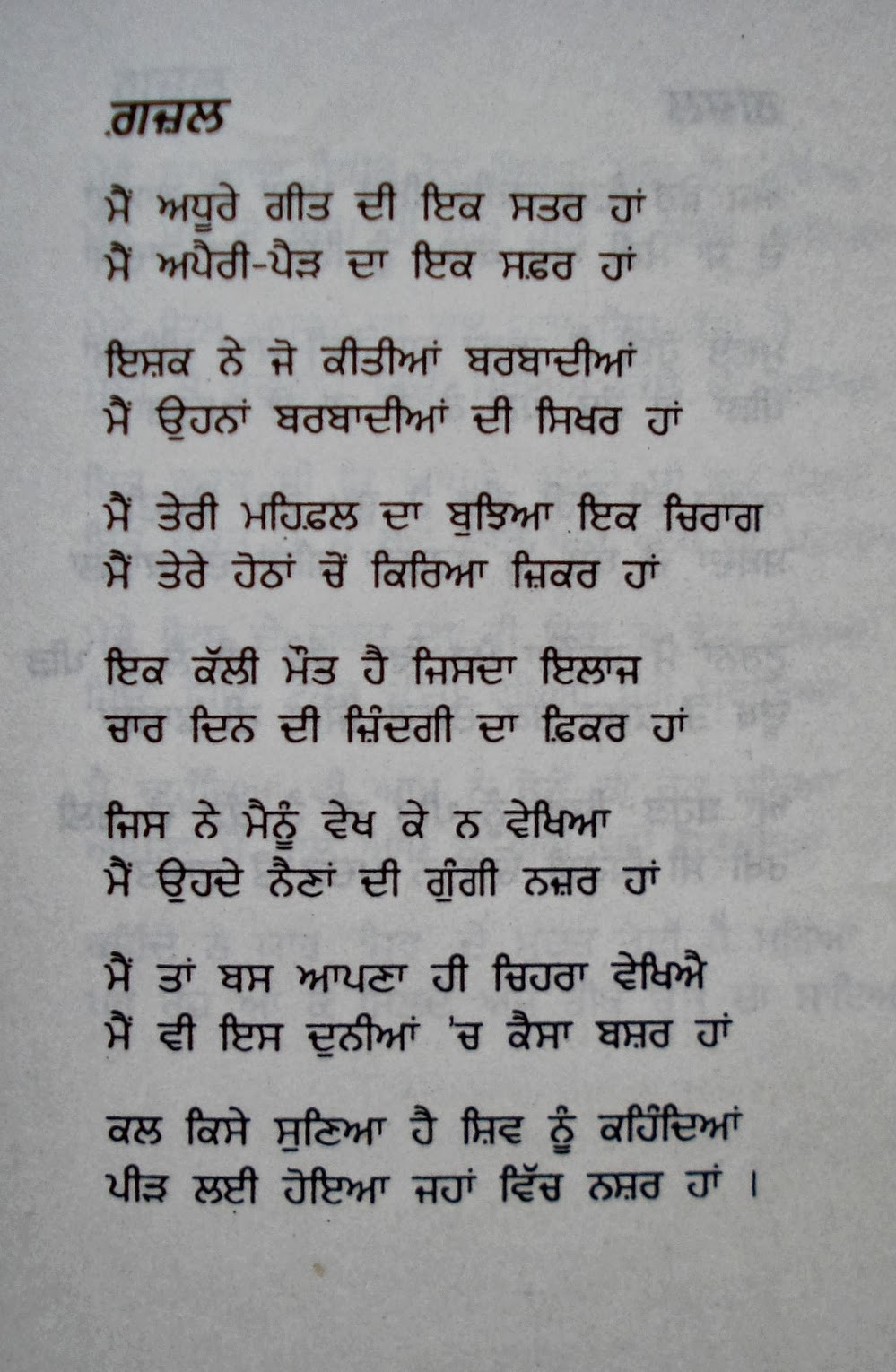
ghazal

i am a sentence in a song incomplete
a journey of the footprints not made by any feet

of all the havoc that love has wreaked
of those ravages i am the peak


i am a lamp in your gathering that’s snuffed out
i am an allusion that from your lips leaked


that has death alone as its cure
i am the anxiety for such a life worth just a week


she, who saw me and looked away
i am the mute gaze of her eyes deep


my own face alone have I seen
what a strange man in this world I have been !


someone heard shiv say yesterday, sorrow’s
left me well known in this world bleak


Longing

people worship god
and i, your longing
it’s a hajj to a hundred meccas
oh your longing!
people say I have become the sun
people say i shine gloriously
what kind of a fire it lit me with,
oh your longing!

behind me is my shadow
in front of me, my darkness
my arm it mustn’t let go
oh your longing!

no soil of the body in it
nor garbage of the mind
i sifted it on a winnow
oh your longing!

whenever times of sorrow came
bringing pain and loneliness in tow
i called for it to come sit by my side
oh your longing!

it gets me to dye words sometimes
and sometimes makes me weave songs
a thousand crafts it’s taught me
oh your longing!

when pain fell at my feet
and swore by my perseverance
the whole world turned up to see
oh your longing!

through my passion i gained some standing
people came to congratulate me
and embracing me freely wept,
oh your longing!

i am a fool with no sign of sagacity
this the world told me
on a pedestal it’s put me today
oh your longing!

it’s a hajj to a hundred meccas
oh your longing!


*Thanks to TSC friend Taseer Gujral for her editorial suggestions

10/6/16

Poems | Shiv Kumar Batalvi ( Translated by Sartaj Ghuman) | Part 1/2


Photo : LeeLa

borrowed song

oh sweet lord
lend me another song or a half
my fire’s going out please
give me another spark

in my early years of infancy
i’ve laid all my hurt to waste
for the season of my youth now
please lend me more pain chaste

give me a song like my youth
dusky, mystically beguiling
like the red of the day at dawn
sets aglitter the whole tank
or like in a treeless land
at twilight the first star
in my land too it’s getting dark
give me another star or a half
or like the redness fiery
in the lake dissolve me
without a lover i can spend days long
but not, o lord, without a song
a lifetime anyone can squander
a fortunate few are fated pain
and lord, is every shore graced
by a doe sipping at the lake
drain away the untouched waters then
of my lake too unclaimed
or the songs that you got me to write
take those too back again

let me not extol beauty
that as an equal to fire doesn’t stand
and not praise the eye, o lord
whose tears are but bland
let me not sing songs that aren’t in pain steeped
or say words that aren’t fragrant scented sweet
if not fragrant my words happen to be
break them off the branch
or like my youth lend me
another song or a half

in my early years of infancy
i’ve laid all my hurt to waste
for the season of my youth now
please lend me more pain chaste


virtuous father dear

when the cotton does flower bear
o virtuous father dear!
buy me that season of the year
o virtuous father dear!
i lost a song in this season of yore
that of longing a garland wore
its face pockmarked with sorrow such
its eyes full of water from a ruined well
a song that when by the lips touched
sends the heart fluttering along
o virtuous father dear!
buy me that song
o virtuous father dear!

one day me and my song
in this season bewitched beguiling
the heart’s soil we ploughed
and dreams pure we sowed
with a million tears we irrigated it
no flower it bore however
o virtuous father dear
buy me just one flower
o virtuous father dear!

what use all your land
if daughters are to wither so
what use your mansarovar
if thirsty the swans go
to what end your scattered crumbs
against pearls weighed
o virtuous father dear!
if you can’t buy me that season of the year
o virtuous father dear
when cotton does flower bear
o virtuous father dear!


gazal

of dealing with sorrow, i’ve learnt the art
learnt to slowly cry and distract the heart

it’s best that you are someone else’s now
it's put an end to worries of making you mine somehow

oh you who breathe, but for this one fear i’d readily die
they sell for money even the land to light the pyre

my friends, lend me not these breaths
for i have not the courage to repay the debt

don’t try and drive shiv’s sorrow away
the treacherous rascal has a mind to cry today


4/5/16

TSC Interviews | Nilanjana Roy


1.     Through a personal history of reading, you have also sketched a brief history of Indian writing in English in India. How difficult was it to weave in the two together, in terms of writing it down?


It was a pitched battle between enthusiasm and laziness. But the history of Indian writing in English is so colourful – printing presses abducted from ships, early speculative fiction that imagines the British being conquered by an uprising of tribals, bilingual and trilingual editors who shuttled between Urdu, Persian, Bengali, English, Sanskrit, Gujarati at need, an Indian woman poet who spoke French, wore silk dresses but could unselfconsciously write about Sita in the sacred grove, and died tragically young. It finally wore down my sometimes epic laziness.

I used personal memory and experience as a jumping-off point into this history in part because I discovered Indian writing in English accidentally and haphazardly, and wanted to make it clear that The Girl Who Ate Books is a personal reading history, not a truly scholarly history of Indian writing in English. You have to be very careful not to overdraw on the account of memory – nostalgia is a trap, isn’t it? But I drew courage from Anne Fadiman and Rokeya Begum, who used personal history as a way of exploring far larger literary histories, though I think both of them did it more expertly than I have.


2.     The festival at Neemrana occupies an important place in the narrative and you cite it in a few different contexts. You also write about the schism that seemed to exist between the hosts and guests of the festival and the locals.  More than a decade down the line, how do you see the evolution of literary festivals? Do you think that schism still exists - sometimes as an inevitability due to language and class - between writers of Indian English fiction and the Indian masses?

One of the successes of literary festivals – not all, but a substantial number – is that they’ve grown better at bridging the gap. Of course litfests stand in danger of turning into very long self-congratulatory parties, too. But one reason why I like the Jaipur festival is because it’s managed to make that big tent democratic – the local chemist, auto drivers, mithaiwalas will show you their five-day passes and sometimes point you to the best sessions to attend.

We have very old templates for literary festivals in this country, from mushairas to itihas sammelans and the old tradition of kathakars and patachitra storytelling. Most of these traditions were inclusive, and where they weren’t, it is up to us to create new, radically inclusive traditions.

The problem with the evolution of literary festivals is that it’s only literary awards and litfests that are thriving – the rest of the crucial creative infrastructure that all Indian writers, not just Indian writers in English, need is missing. If you want to grow good writing, good editing, there must be far more direct support for writers themselves. The places where you can teach and learn skills, the residencies, fellowships and grants for writers especially for those who don’t have access to the resources of big cities, the public libraries and bookshops where young writers can have their minds fed are missing.

We have not built a literary culture, and given the present climate of anti-intellectualism, we are likely to dismantle the few individual efforts to create one. Litfests at their best provide writers with a platform where they can connect with readers, and with a place where they can listen to and meet their peers and mentors. But litfests cannot replace a thriving literary culture, and we do not have even a single Indian city that can be proud of its libraries, its bookstores, that can say, “Our writers have the freedom and the support they need to flourish.”


3.     Chetan Bhagat with whom you had a Twitter spat recently does not figure at all in the narrative. He is someone who is often credited for bridging the schism between the writers of English fiction and the masses. How do you place him? Is he a good or a bad influence when it comes to IWE?

The Girl Who Ate Books features interviews with 14 writers, and profiles of several more from the 18th and 19th centuries. It was difficult for me to limit this selection to Indian writers in English, and there are multiple omissions – Cornelia Sorabji, Sarojini Naidu, Imtiaz Dharker, Hansda Sowvendra Shekhar, Arundhathi Subramaniam, Janice Pariat, Anees Salim, Amitav Ghosh, Suketu Mehta, to name just a few writers I’d have liked to have seen in the book. I couldn’t locate the full transcript of my interview with Suketu Mehta, and sadly, our youngest cat had unspooled the original cassette tape and eaten some of Suketu’s words. (With great enjoyment.)

There’s a flourishing industry in Chetan-appreciation or Chetan-criticism, and there is enough of both for the world to get by without my opinion of him. I was saddened in our Twitter disagreement, over the issue of the Indian writers who had returned their awards in fear and anguish after the murder of the scholar MM Kalburgi, to see that he was ignorant and contemptuous of the writings of Indian authors in translation who took an active part in these protests.

He said his books were more famous than theirs, which is a dubious claim to make about writers such as Krishna Sobtiji or Surjit Patar. I wish he had not fed  the old stereotype of the bestselling Indian writer in English who remains condescending of his counterparts in other Indian regional languages; this attitude has caused a great deal of damage in the past.


4. A number of writers featured in the book-  and I admire several of them - seem familiar with the high-life, like specialities at five-star hotels, in a way that will most likely be difficult for a Bhasha writer to be. Their education and background is also of a more elite kind, compared to what one generally sees when it comes to Bhasha writers. Even dynasty seems to operate - Moraes, Thayil, and Desai for example had illustrious writer-parents. Do you think this phenomenon is at least, one of the reasons behind the resentment - if one may call that - that one sees sometimes, as in the case of Nemade and Rushdie for example?


The resentment has far deeper roots, it goes to the heart of the question of whether Indian writers in English have transmuted English alchemically into just another Indian tongue, or whether as in some cases, they remain dangerously ignorant of the work that is being done across Indian languages.

But when we’re looking at language as power, there should also be the acknowledgement that Indian bhasha writers often have large readerships that Indian writers in English might envy – the Bengali writer Sankar was amused to be told that a sale of 30,000 copies in the English language market was considered excellent, since his usual sales in Bengal for each book goes into lakhs.

I don’t agree that bhasha writers lack sophistication – so many are very well-travelled, in their own countries, in Asia as well as the US and Europe. Nirmal Verma was a Stephanian, lived in Prague, travelled across Europe, Mridula Garg has connected with readers in Europe and Japan, Shrilal Shukla was an IAS officer, for instance.


Photo by Kavi Bhansali

5. You have also touched upon the issues related to authenticity while citing the points raised by late Meenakshi Mukherjee in this regard. While in the specific case of Chandra, he may have used the section-heads according to a genuine need, how do you place the issue in an overall context? For example, a novel by a Nepali writer comes to mind, called The Gurkha's Daughter, a title that signals Nepal to the West in a rather orientalist way. While I am not disputing the genuine merit of the works, are we in India and the sub-continent still performing for the West?

Two chapters in The Girl Who Ate Books – Finding Dean and Pioneers: An Unbroken Line of Trust – address this question.

Let me throw out an additional provocation: why are Indian writers, across languages, so relatively uninterested in performing for Asian readers? Where is the hunger to be on the bestseller lists in China, which I must confess is a lurking personal ambition, to be reviewed in Shanghai, adulated in Hong Kong, welcomed to Malaysia, dissected in Laos? Why don’t we want to be big in Japan?


6. While the book contains interviews with poets, it does not give us a narrative as structured of Indian poetry in English as it does with prose. Can we expect another book that covers it? There are some who actually believe that poetry in Indian English has been better in quality but due to negligence, had to suffer obscurity. Your views?

In Class VI, I had necessarily unrequited crushes on Julio Cortazar, Pablo Neruda, Adrienne Rich and Shei Shonagon, all of whom were so far above my reach that none were in a position to return my love, some for the very good reason that they were dead. This is the same sort of relationship I have with poetry – it is an unattainable lover because I know so little about the art of the poem, and do not have the formidable learning of an Arvind Krishna Mehrotra, or the critical tools of an Arundhati Subramaniam.

I agree that Indian poetry is the best of Indian writing, especially in English. Jeet Thayil wrote about many lost Indian poets in an issue of Fulcrum and in his anthology of Indian poetry, and I remember Eunice de Souza’s equally important Nine Indian Women Poets.

Poetry is obscure only because we have grown so used to judging writers by the standard of success, which is to say sales, which is to say we are treating books as though they were bolts of cloth. Poetry is like the best of Indian weaving – exquisite but sturdy, under-appreciated, those who put on the garments of handloom-woven poetry cannot go back easily to machine-made bestsellers, and somehow, it survives despite the many threats. “No one buys poetry,” people say, but so many people remember it, recite it, secretly need it. If you reject poetry, you are left with the tyranny of slogans, the impoverished language of hypernationalism and threats.


7. The problem of the "clique" in IWE has been a long-standing one. Sometimes writers like Nagarkar seem to suffer obscurity because they don't belong to one. How can this be overcome?

It is not a clique as much as it is a joint family system with the biradari, the rishtedars and the patidars vying for space. At any point, somebody is having a property dispute, someone has taken over the house keys, someone is fighting with a junior cousin.

And as with all joint families, it is also possible to step away from the construct itself and live a perfectly independent life. You will notice that Nagarkar is no longer obscure and that he has found his readers despite the early struggles and the opposition of the Marathi literary establishments.

See the ease with which these cliques can be entered – there is a cycle to it, one year a writer is accusing the literary community of being very cliquish, the next he or she is accused of being an eminence grise. But you will also notice that the ones who are doing the best writing surface at literary festivals like dolphins perform briefly, and then swim back into the ocean and stay away from the rest of the politics, as any sensible dolphin does. (Writers are not dolphins, though, let us not stretch these analogies too far. It is a pity, I would have liked to have been a dolphin instead of a writer but you can’t always get what you want.)


8. You have also meditated on the process of writing - by calling it a process of laying down a structure that does not really exist but you make it hold with your sheer conviction. Did that hold true for the sequel to Wildings also?

One-half of writing is imagination, and that is a true mystery. I do not believe any of us can take credit for the seeds of each story – they come out of nowhere, whether it is Nabokov’s Lolita or a far less ambitious story about a clan of cats battling it out in Delhi, finding unlikely alliances with zoo tigers or with a cheel who has significant parenting anxieties. Creativity is a mystery, and I imagine that there is a real ocean of seas of stories in a parallel world, and that everyone is given a boat, and that you can choose whether or not to steer your boat in the direction of that ocean over the course of your life.

I loved writing The Hundred Names of Darkness not just because of the imagination but because I was learning the craft, structure, some technique, perhaps very inexpertly, but still. If your characters are animals, then it falls to you to try to imagine all of the animal world – it won’t work unless you can consistently see Delhi from three feet off the ground, and understand what the city or Goa would feel like to non-humans. Would it be friendly? Hostile? Full of adventures? Full of bait? Are you predator, prey, or both?


9. What do we expect next from you? Another novel? Or non- fiction? Or something else altogether?

Thanks for asking. Some years ago, the figure of a butcher began to haunt me, a man who cut meat beautifully, and who had honed his trade in a bloody war, and come to Delhi to escape his memories. Over time, I learned a little more about him, he had arrived in the city just as the Emergency began, and he was not the main character. His job was to point me in the direction of two places.

One was Delhi in the 1970s, a city of low rooftops, a time when the Yamuna ran so clean that you could bathe in it, or use it to bury all kinds of sins. The other was Haryana in the same decade, and I had a recurring set of nightmares, after some reporting on gender, where I saw road maps laid out connecting canals, small towns, farmland, industrial landscapes through the bodies of women who had gone missing. These two things, a character and an image, are coming together in the next book. It will be fiction, mostly.